
Mooring a boat – A guide to safe mooring at the dock and buoy
Mooring your boat correctly is the difference between a carefree summer and expensive damage to the hull, cleats, and docks. Safe mooring requires the right kind of rope, effective mooring snubbers, and a geometric layout that allows the boat to move with the water level without hitting the dock. By combining the correct line dimensions with smart shock absorbers and chafe protection from our mooring and anchoring range, you protect your boat even when storms roll in.
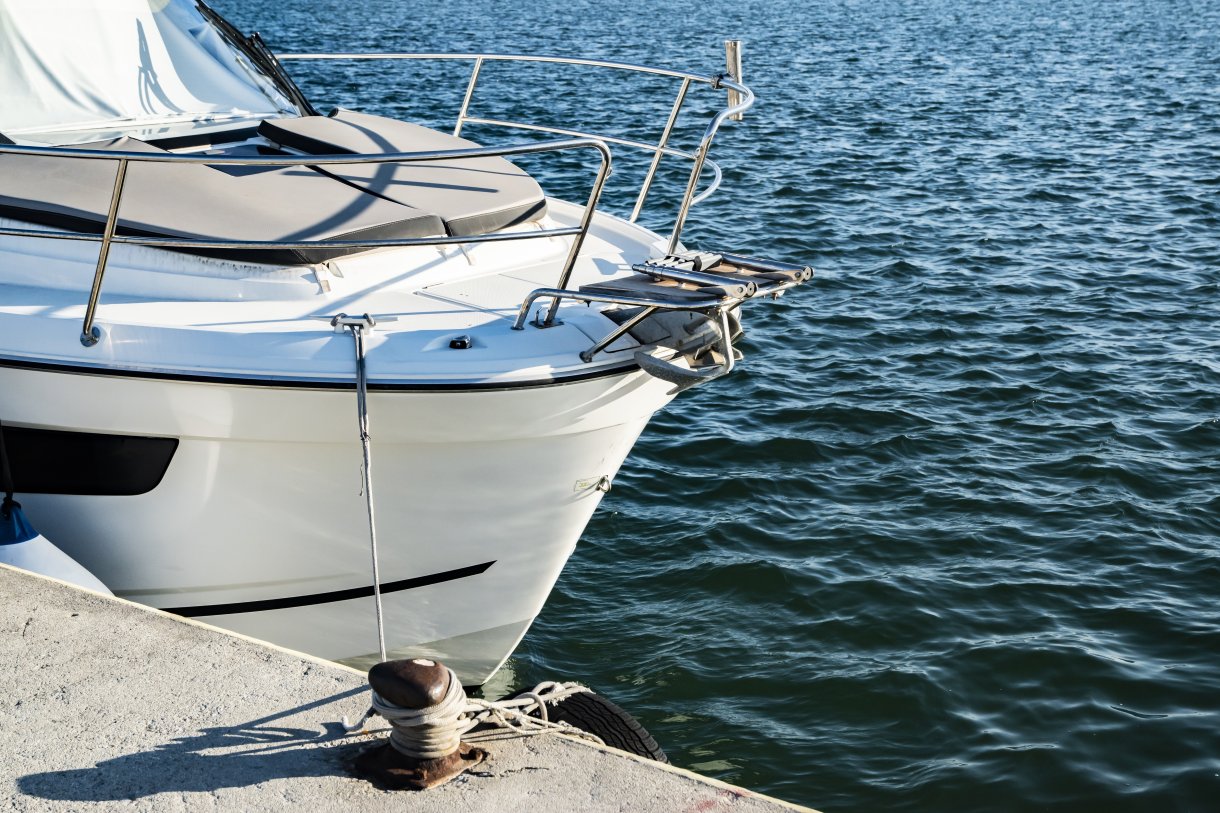
Quick guide to safe mooring
For those who quickly want to ensure the boat is safely secured in the marina, we have compiled the most important steps for how to moor your boat safely:
Right dimension: Always adapt the thickness of the line to the actual weight of the boat.
Shock absorption: Always mount rubber snubbers on all permanent mooring lines to protect the cleats.
Double lines: When mooring at a buoy or preparing for a storm, always use double lines where one acts as a slack safety line.
Chafe protection: Thread protective sleeves over the lines where they risk chafing against fairleads or dock edges.
Choose the right mooring line: Material, construction, and dimensions
Today, most people use braided rope for mooring and anchoring. A good mooring line must be strong, UV-resistant, and elastic enough to absorb sudden shock loads. Here are the most important materials to keep track of:
The material
Polyester (Our top pick): Polyester is one of the most common and highly recommended materials for mooring ropes. It sinks in water, has excellent UV resistance, and retains its strength for many years. See our polyester ropes.
Polyamide (Nylon): Even more elastic than polyester, providing a naturally dampening effect. Perfect when you need maximum stretch, but keep in mind that it loses about 10–20 percent of its strength when wet and can shrink slightly over time.
Polypropylene: A cheaper material that we generally only recommend for temporary mooring or if you size up significantly. Standard polypropylene is very sensitive to sunlight and also floats, which increases the risk of getting the line caught in the propeller. To our polypropylene ropes.
The construction
When choosing the construction, the choice is usually between three-strand rope and braided line.
Three-strand lines are classic, easy to splice yourself, and have natural elasticity built into the construction.
Braided lines (often with a core and a cover) are softer to handle, rarely kink, and have a more modern look, but require a different technique to splice.
Dimensions
What thickness you need depends entirely on the weight of the boat and how exposed your berth is. The rule of thumb for sizing mooring lines is based on the boat's weight and length. For a standard boat (motorboat or sailboat), the following generally applies:
Boat weight up to 1 ton: 10 mm
Boat weight 1–3 tons: 12 mm
Boat weight 3–4 tons: 14 mm
Boat weight over 4 tons: 16 mm or thicker
Note: Local conditions such as strong currents, large windage, and exposed locations may require you to go up one or more dimensions in your line choice to increase safety margins.
Mooring snubbers: The most important protection for your boat and dock
Every permanently moored boat must be equipped with mooring snubbers (shock absorbers) on all fixed lines. Without dampening, the violent forces from waves and wind gusts are transferred directly to the boat's cleats and the dock's fittings, which sooner or later leads to cracking in the fiberglass or fittings being torn off.
Rubber snubbers have several practical advantages over traditional steel springs. They don't squeak, don't rust, and provide soft, progressive dampening without the need for the heavy safety chains that steel springs require according to many local marina regulations. When installing a rubber snubber, the line should be threaded through the snubber's holes and wrapped around the body. The number of turns the line is wrapped around the snubber should always follow the manufacturer's specific instructions for that current model and line diameter to provide optimal dampening and lifespan.
Remember to always match the mooring snubber with the thickness of the line. A snubber that is too small for a thick line will wear out in no time. If you instead choose a snubber that is too large for a thin line, the entire setup becomes too stiff. Then the dampening effect disappears completely. The result is that the cleats take the full impact anyway. For extra safety, you should always have a safety loop (a slack part of the line that bypasses the snubber) so that the boat stays put even if the rubber were to unexpectedly break under extreme load.
Mooring technique at the dock: Bow lines, stern lines, and springs
To lie safely alongside or with the bow towards a dock, it is not enough to simply tie the boat at a right angle. You must work with angles and opposing forces to secure the boat's position in all directions.
To moor the boat correctly at a dock, three specific types of lines are needed:
Bow lines and stern lines: These lead diagonally outwards from the boat's bow and stern to the dock. They keep the boat close to the dock but allow some lateral movement.
Springs (forward spring and aft spring): The springs are the most important lines to prevent the boat from moving forward or backward. A forward spring runs from the bow aft towards the dock, while an aft spring runs from the stern forward towards the dock. These lines should cross each other and be relatively long to handle tidal changes and wind pressure without being stretched to the breaking point.
Breast lines: These are primarily used for temporary docking or in very tight spots to keep the hull parallel to the dock, but should be avoided as a permanent solution because they become too rigid when water levels change.
When mooring the boat by the dock, the lines should ideally have an angle of about 45 degrees to the dock where possible. This provides the best balance between keeping the boat in place and allowing it to follow vertical movements as the water level changes.
Mooring a boat at a Y-boom and buoy: Avoid the most common mistakes
Mooring a boat at Y-booms (finger pontoons) or mooring buoys requires specific techniques to avoid unnecessary wear on both the boat and the marina equipment.
At a buoy
When mooring the boat at a buoy, you should attach the mooring line to the buoy's bottom ring (or to the rod/chain that goes directly down to the mooring block), and never solely to the buoy's top lifting ring.
Always use double lines to the buoy: a primary line that is tensioned and equipped with a mooring snubber, and a secondary safety line that is slightly longer and lies slack. If the primary line snaps or the shackle comes loose, the safety line saves the boat from drifting away. Use a robust mooring hook made of high-quality marine-grade stainless steel (duplex or AISI 316) and ensure the hook has a safety catch that cannot open on its own when the line goes slack.
At a Y-boom (finger pontoon)
When mooring between Y-booms, you should use sliding rings along the booms. This allows the mooring point to move freely up and down with the water level, reducing the load on the cleats. Moor the boat as centered as possible between the booms and ensure the lines are tight enough to prevent the boat from swinging and hitting the booms' metal structure.
Protect the lines from chafe and wear
Even the best rope can wear through in a few hours if it rubs against a sharp edge, a concrete dock, or in a fairlead. Mechanical wear (chafing) is one of the most common reasons why mooring lines break.
Always protect your mooring lines with durable protective sleeves (chafe guards) in the places where the line passes through the boat's fairleads or rests against the edge of the dock. You can use specially made protective sleeves of polyester, heavy-duty reinforced plastic tubing, or pieces of decommissioned fire hose that you thread over the line and secure with a couple of cable ties or a lashing.
Also, make sure that metal fittings, shackles, and thimbles are in good condition. A spliced eye around a stainless steel or plastic thimble protects the eye of the line from being worn down by the shackle. When connecting the chain, buoy ring, and line, all shackles must be secured with stainless steel wire or cable ties so that the pin cannot unthread itself due to the constant movements underwater.
Storm mooring: How to secure your boat for bad weather
When meteorologists issue gale or storm warnings, a standard everyday mooring is not enough. You must actively prepare the boat for extreme forces and rising water levels.
Go through the following checklist when a storm is approaching:
Double the lines: Lay out extra bow lines, stern lines, and springs. The extra lines should run parallel to the regular ones but be slightly slacker, so they only take over the load if the primary lines break.
Check the fenders: Hang out extra fenders on both sides of the boat. Place them both high and low, as strong winds can cause the boat to heel heavily or be pushed under the edge of the dock at extremely high tides.
Adjust the distance to the dock: Pull the boat out a bit further from the dock if the wind is pushing towards the land, so the hull does not risk hitting the dock when the snubbers are stretched to their maximum.
Reduce windage: Take down the canvas cover, sprayhood, exterior cushions, and sails (if possible) to reduce windage. A canvas cover left up in storm-force winds creates enormous forces that put severe strain on the mooring lines.
Check the bilge pump: Ensure the batteries are fully charged and that the automatic bilge pump operates free of debris, as heavy rain can quickly fill an open boat and dramatically increase its weight.

Marine blue mooring line with hook Garda 24
€ 14.14

Danfender foam-filled hard plastic buoy
€ 100.16

Fender, grey - CASTRO
€ 17.91

Orange ball fender with black top
€ 32.48

Sheet and trim line MX white/red
€ 1.24
